🎉 Now on the App Store · Free to download

Fall in love with the Quran — one word at a time.

SurahKids turns learning surah meanings into a daily habit you look forward to. An ayah a day, seven ways to practise the same words, and a review queue that brings each one back just before you would forget it. Start with no account at all.

★★★★★ Grounded in learning science · for every age

Start learning today 🌙

Free to download on iPhone & iPad. Unlock every surah with a one-time purchase.

Download on theApp Store

📱 On Android? Get notified when it lands:

🔒 No spam, ever. One email when Android is ready.

You're on the list! 🎉 One quick question…

SurahKids is free to start. To unlock all 37 surahs, the full review queue and every practice mode — forever, would you pay a one-time $10 for lifetime access?

🌙✨

JazakAllah khair!

You're officially on the waitlist. We'll be in touch soon, inshaAllah.

🎁 Founding members will get lifetime access at launch
The SurahKids home screen: an ayah of the day with audio, the surah you are part-way through, a spaced-repetition review queue, and the Juz Amma progress grid.
Light & dark Ayah of the day Spaced repetition All 37 surahs
The training loop

Learn → Play → Celebrate

A 5-minute daily loop, designed for short attention spans. Every session ends with a win.

1

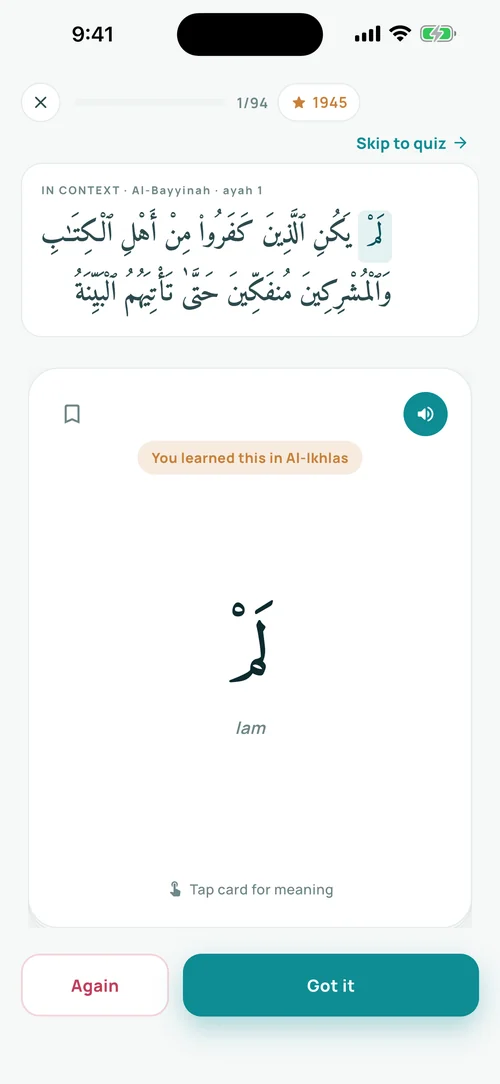
Flip a flashcard

One word, big and beautiful, with audio. Tap to reveal the meaning. No clutter — just focus.

A flashcard showing one Arabic word with its transliteration, and a button to hear it.
2

Pass a quick quiz

Match the word to its meaning. Instant green-or-coral feedback. Mistakes cost a heart, never confidence.

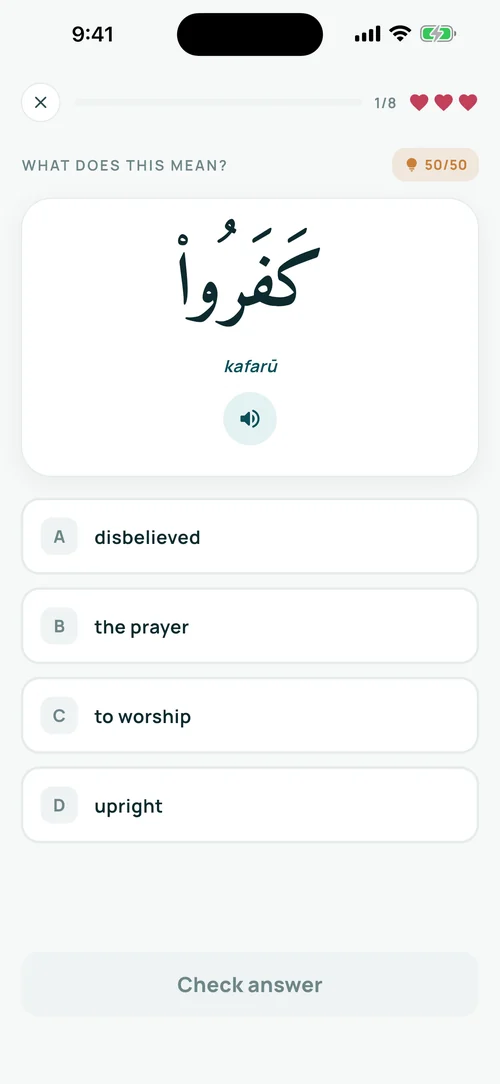
A multiple-choice question asking what an Arabic word means, with four answers.
3

Earn stars & keep the streak

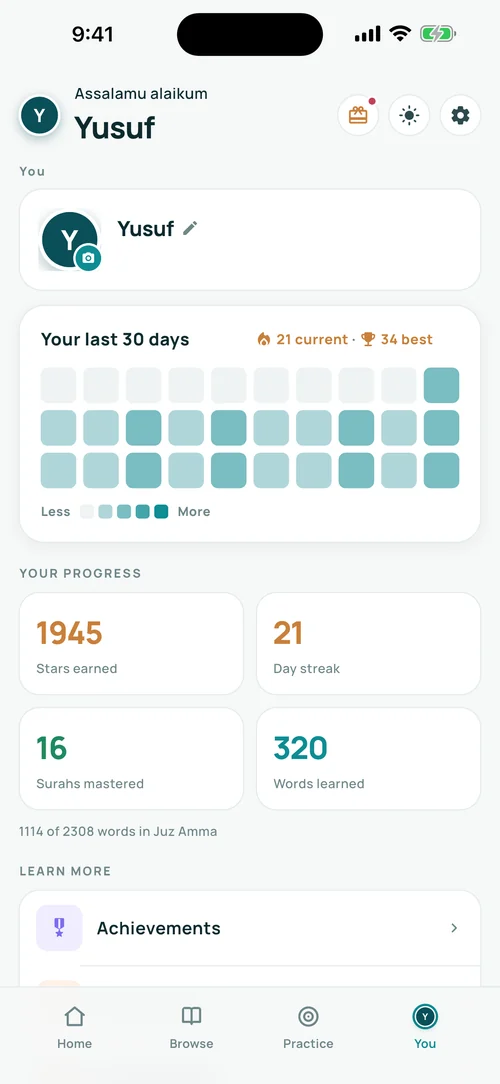
Stars for every session, a day streak, and a heat map of the last thirty days. Surahs mastered and words learned, counted — the payoff that makes tomorrow’s session easy to start.

The profile screen showing stars earned, day streak, surahs mastered and words learned.
New in the latest version

A bigger app than it was

The last release rebuilt the whole interface and added three things worth opening the app for.

Seven ways to practise

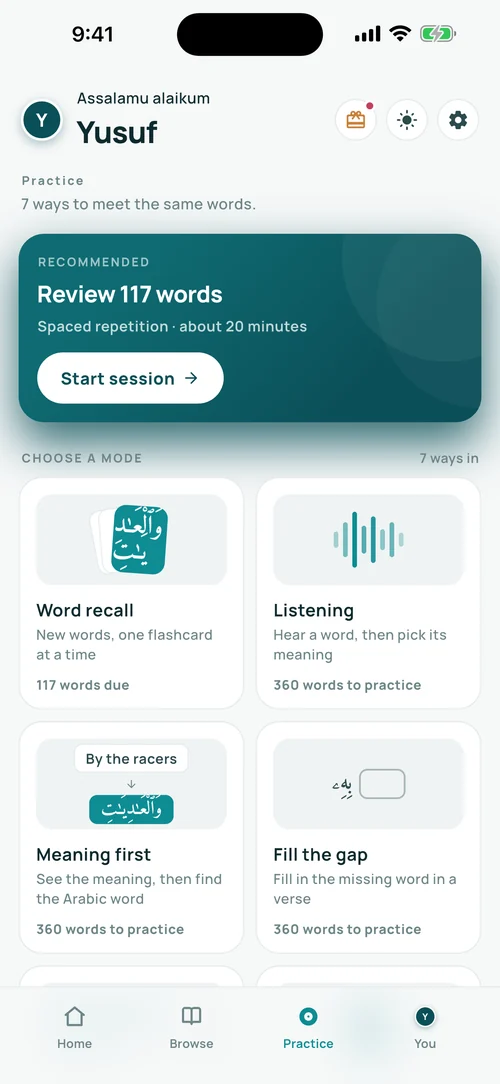
A practice hub, not one drill. Word recall, listening, meaning first, fill the gap, common words, a random quiz and Next Ayah — the same words met from a different angle each time.

The practice hub listing seven modes: word recall, listening, meaning first, fill the gap and more.

The Ayah Game

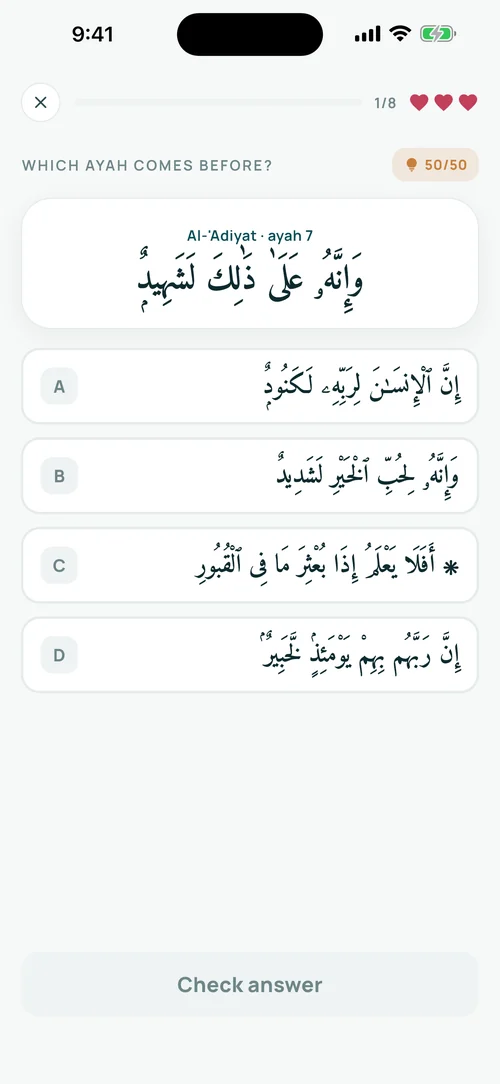
It shows you one ayah and asks which comes next — or which came just before. Recitation breaks down at the joins, and that is the part nothing else drills.

The Ayah Game asking which ayah comes before the one shown, with four choices.

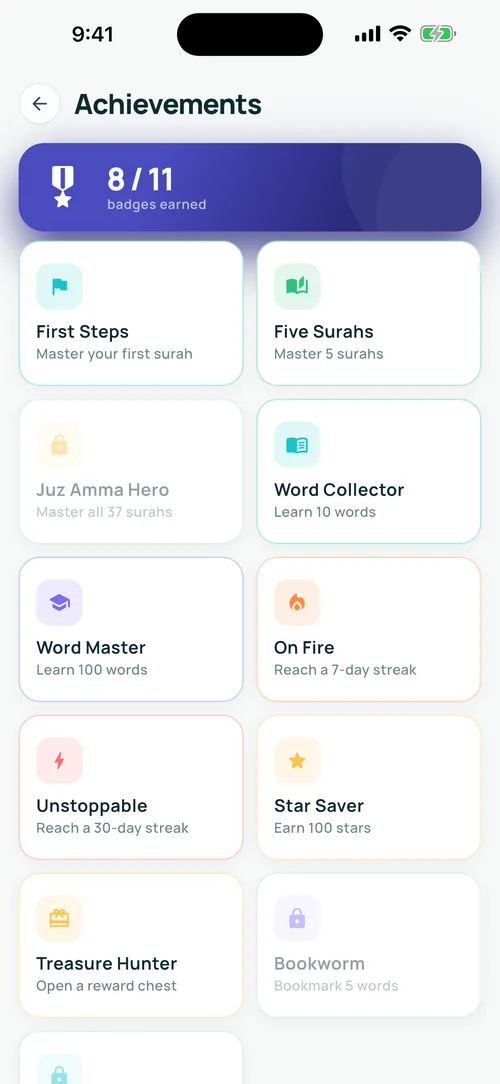
Eleven achievements

Badges for streaks, stars, words learned and surahs mastered. Small goals for the days when the big one feels far away.

The achievements screen showing earned and locked badges.

Also new: a redesigned home screen with an ayah of the day, a light/dark theme control, and Japanese — the eighth interface language.

One app, every screen

Beautiful on tablet, too

More room to learn together. On iPad & Android tablets, the whole surah journey sits right beside the lesson — perfect for studying on the couch.

Juz Amma🔥 7
✓An-NasMasteredالنَّاس
✓Al-FalaqMasteredالفَلَق
▶Al-IkhlasIn progressالإخلاص
🔒Al-MasadLocked
🎁Reward chestUnlock at 5
✕
⭐ 5
Surah Al-Ikhlas · 1
اللَّهُ أَحَدٌ
Allāhu Ahad
MEANING
"Allah is One"
The psychology

Built so you actually stick with it

Every feature is grounded in how people focus, feel, and remember.

⏱️

Bite-sized by design

Attention for focused study runs short. Sessions are short, single-word, and finishable — so you win every time.

🔥

Streaks that gently pull

A daily flame and a growing streak give a reason to come back tomorrow, and the review queue tells you exactly how many words are waiting.

🎉

Instant, warm feedback

Green for success, soft coral for "try again." Hearts make mistakes feel playful, never like failure.

🗺️

Progress you can see

Every surah you master fills in on the Juz Amma grid, and reward chests unlock at milestones — invisible progress becomes something you can point at.

👆

Effortless to use

Big touch targets, simple gestures, and audio-first cards — no Arabic keyboard, no setup, no manual.

🤲

Faith-positive tone

"MashaAllah!", respectful Arabic typography, and a warm, joyful voice — never a sterile test.

Everything you need

Everything in one ad-free app

From a seven-mode practice hub to badges and reward chests, SurahKids is packed with features that make learning personal and keep it moving — in eight languages, light or dark.

🦊

Profiles & progress

Set a name and photo, track your stars and streak, and watch a coverage bar show how much of Juz Amma you can read.

📖

Word-by-word Reading

Read full surahs with meaning. Tap any word to hear its pronunciation and see its translation instantly.

🌟

Common Words

A dedicated mode to master the 1000 most frequently used words in the Quran — learn these and you recognise them everywhere.

🎲

Random Quiz · 3 levels

Mix it up! A surprise quiz in Easy, Medium or Hard — test memory, keep the streak, and earn extra stars across everything learned.

🔒

Private by default

No advertising, and no tracking of what you do in the app. Your progress is yours, and you can delete your account and everything in it at any time.

⏰

Gentle Reminders

Pick a time and we will remind you only on days you have words waiting — once a day, never more, and off unless you ask.

🧠

Seven ways to practise

Word recall, listening, meaning first, fill the gap, common words, a random quiz and Next Ayah. The same words met from a different angle each time, which is what makes them stick.

🚀

Start without an account

Tap once and you are on the first word of An-Nas. No name, no email, no password. Make an account later and everything you already earned comes with you.

🌍

Eight languages

English, Arabic, Urdu, Turkish, French, Indonesian, Malay and Japanese — with right-to-left layout for Arabic and Urdu. Word meanings themselves are in English.

🌙

Light or dark

A real theme control in Settings: light, dark, or follow your phone. Five accent colours if you want the app to look like yours.

🧩

Ayah Game

Guess which ayah comes next. You learn how a surah actually unfolds, not just the words standing on their own.

🏆

11 achievements

Badges for streaks, stars, words learned and surahs mastered — small goals that keep the habit going on the days motivation does not.

The content

Start with Juz Amma — the surahs everyone learns first

Word-by-word meaning, transliteration, and audio for the short surahs almost everyone begins with. More juz added over time.

النَّاس An-Nas
الفَلَق Al-Falaq
الإخلاص Al-Ikhlas
المَسَد Al-Masad
النَّصر An-Nasr
الكافِرون Al-Kafirun
الكَوثَر Al-Kawthar
الفيل Al-Fil
+ all of Juz Amma →
The method

Why learning word by word works

The whole approach rests on one fact about the Quran’s vocabulary. It is worth understanding before you download anything.

Most of us learned the sound before the sense

If you grew up in a Muslim family, you probably learned to recite Juz Amma years before anyone told you what it meant. The words became familiar as sound — a shape your mouth knows — without ever becoming familiar as language. That gap is completely normal, and it is the gap this app is built to close.

The usual way to close it is to read a translation. That helps, and it is not enough. A translation tells you what a verse means; it does not tell you what any particular word means, so the next time you meet that word in another surah you are no better off than before.

Juz Amma has far fewer words than you think

Juz Amma — the last thirtieth of the Quran, and the part almost everyone learns first — contains 37 surahs and 564 verses. Read end to end, that is 2,308 words.

But those 2,308 words are made up of only 1,448 distinct forms. Roughly a third of everything you recite is a repeat of something you have already said. And the repeats are not spread evenly: the most common hundred forms account for about a third of the running text on their own.

That is the entire argument. You are not learning 2,308 things. You are learning a much smaller set, most of which you will meet again within a few surahs.

What that feels like in practice

Start with An-Nas, six verses, and every word is new. By the fourth surah, some words are already familiar. By the time you reach An-Naba — the longest in Juz Amma, and the one that looks most intimidating — about 36% of the words in it are words you have already met elsewhere.

So the surahs get longer and the work does not get harder in proportion. That is the opposite of what most people expect, and it is why word-by-word learning compounds while verse-by-verse translation does not.

A worked example: Surah Al-Asr

Al-Asr is three verses and fourteen words — one of the shortest complete arguments in the Quran. Here is how the first verse looks broken down:

ArabicTransliterationMeaning
وَٱلْعَصْرِwal-ʿaṣriBy the time

One word, and it carries the oath the whole surah is built on. ʿaṣr comes from a root to do with pressing, and applied to time it is rendered variously as “the time”, “the age”, “the declining day” or “the afternoon” — the afternoon prayer carries the same name. No single English word covers it, which is exactly why seeing the Arabic matters more than reading a translation of it.

We have written this out for several surahs already. Surah Al-Asr word by word takes all three verses; Surah An-Nas and Surah Al-Ikhlas do the same.

Learning it once is not the same as keeping it

Meeting a word is easy. Still knowing it three weeks later is the actual problem, and it has a well-studied answer: review a word just before you would have forgotten it, and each successful recall pushes the next review further out.

That is what the app’s review queue does. A word you have just met comes back tomorrow; get it right and it returns in three days, then a week, then three weeks. Get it wrong and it starts again — because a word you have genuinely lost is new again, not one step worse than it was.

We wrote about the research behind this in spaced repetition for Quran memorisation and why rereading doesn’t stick.

Where to start

An-Nas. Six verses, and almost certainly one you already know by heart, which means the sound is free and all your attention goes to the meaning. Then Al-Falaq, Al-Ikhlas, Al-Masad — shortest first, so the wins come early.

If you would rather read about the order before starting, which short surahs to learn first lays it out, and the most common words in the Quran covers the frequency argument in more depth.

Free to download

Start your Quran journey 🌙

Download SurahKids free on the App Store — learn the first surahs today, and unlock everything with a one-time purchase.

Download on theApp Store